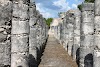
The Colosseum is in Rome, the capital of Italy. All the more decisively, it is on the east bank of the Tiber, the waterway that crosses the city, east of the antiquated Roman gathering. A gathering in ancient history was a land zone during which were the first structures of intensity, even as the big square on which the populace met. It was both a bustling spot to live, a spot to get hitched, enormous gatherings, network gatherings, etc. The arena was not exactly a kilometer toward the southwest, the Capitol was a little over a mile toward the west.
Colosseum was first called the Flavian Amphitheater or in Latin, the Amphitheatrum Flavium. This was after Vespasian and Titus who had the surname of Flavius. It was utilized for gladiatorial challenges, and different shows like creature chases, in which creatures would chase and eat detainees; or in which combatants would battle against creatures. There were additionally executions of detainees, plays, and fight scenes; once in a while it was loaded up with water to take on ocean conflicts. The individuals of Rome could go into the Colosseum with no costs; it was free.
 |
| The Colosseum |
In the Middle Ages, after the mid-fifth century, it was not, at this point utilized for exhibitions. It was then utilized as lodging, workshops, a Christian sanctum, and as a gracefully of building stones. It is currently in ruins due to tremors. The Colosseum is an image of the Roman Empire. It is one of Rome's most famous vacation destinations.
On investigating the type of Coliseum, it ought to be said that it contrasts reliably from different structures of old Rome. The arena is the structure that has an oval structure. The oval field is situated in the focal point of Coliseum, though the whole structure is contained with an unpredictable arrangement of curves in the three-story arcades. Every one of the curves in the second and third-floor arcades encircled sculptures, which were presumably committed to antiquate Roman divinities. In such a manner, the strict subject involves an indispensable piece of the compositional structure of Coliseum. Simultaneously, sacrosanct components in Coliseum are preferably enrichments over evident images of venerating Roman divine beings.
Truth be told, Coliseum was intended to engage people in general. The field of Coliseum was famous for battles of combatants and extraordinary shows sorted out for various events to engage the general population in Rome. A large number of Romans went to Coliseum to watch gladiatorial challenges and open displays just as fake ocean fights, creature chases executions, and other old Roman excitements (Byrnes, 205). This is most likely why the development of Coliseum was progressively unpredictable contrasted with Parthenon since Coliseum had an intricate arrangement of water flexibly to sort out ocean fights when the field of the amphitheater was loaded up with water. What's more, there was a mind-boggling arrangement of pathways to isolate residents, fighters, and creatures. The seats were extended by the social remaining of the crowd. This is the reason agents of various social classes involved various levels in Coliseum. For example, the sovereign and legislators could have the seats nearest to the field, while slaves and ladies had the seats uttermost from the field.

Simultaneously, it is critical to lay accentuation on the way that Coliseum reflected social standards and conventions of old Roman culture. Actually, Coliseum was where the social structure of the Roman culture could be effortlessly followed. In this regard, it ought to be said that the crowd going to Coliseum took puts separately to the economic wellbeing of people, which changed reliably. For example, the head held the focal spot in Coliseum. He had the best spot in the amphitheater and was encircled by monitors and the best and eminent Romans. The significant standard of the position of the crowd in Coliseum was grounded on the societal position of people. The higher was the social status of an individual, the closers their place to the field was. Coincidentally, ladies hold perhaps the least position in the Roman culture. This is the reason they were typically positioned at the upper lines of Coliseum close to slaves who held the most minimal situation in the social progression of old Rome. In such a manner, Coliseum uncovered the social chain of command of the Roman culture.
Moreover, Coliseum was the appearance of antiquated Roman conventions and qualities. Indeed, antiquated Romans constantly regarded, boldness, mental fortitude, status to kick the bucket, and physical power and immaculateness. This is the reason gladiatorsâ€â„¢ battles were incredibly well known in old Rome. Amphitheaters were places where such games occurred. Romans delighted in battles and it was a significant privilege for warriors to battle in Coliseum since it turned into the principle amphitheater of the Roman Empire, the biggest and most mainstream amphitheaters of the colossal realm. Simultaneously, Coliseum was where various exhibitions were sorted out. When in doubt, they celebrated Roman rulers, the intensity of the Roman armed force, and the enormity of Rome (Edmondson, Mason, and Rives, 145). In this regard, it merits referencing maritime fights which were displayed and played in Coliseum. Now, it ought to be said that Coliseum was a genuinely liberal work of old Roman design since it had an exceptionally perplexing development, which permitted to fill the field with water for maritime fights. Also, Coliseum had a very much evolved framework in light of the fact that there were independent territories for combatants, observers, and even creatures, which were frequently in exhibitions and battles composed in the amphitheater.